

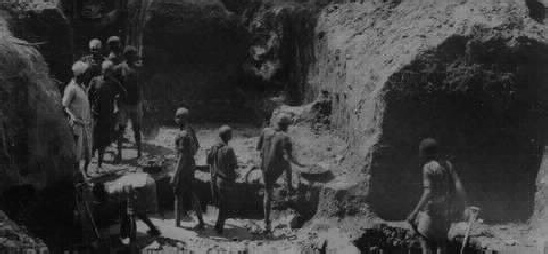
Small scale mining in Tanzania has been going on for centuries. However, the first commercial mining for gold was undertaken by the German colonial administration in the 1890s. This was in the area around Lake Victoria. After the German administration came to an end in 1918, a number of British and South African mining operations started up but it was not until Tanzania obtained independence in 1961 that the mining sector was brought under the direct control of the State.
In the late 1980s the government embarked on a process of privatisation and liberalisation and in the early 1990s it created the Investment Promotion Centre which led to an expansion of the gold mining industry and the attraction of international investors. At this time, a number of large gold mines were established, including Bulyanhulu in Kahama district (with a capacity of 450,000 ounces) and Geita Gold with a capacity of 650,000 ounces.
In addition to the taxes raised by the Tanzanian government from large mining companies, the gold mines improve infrastructure in the form of roads, power and water; create jobs directly and indirectly; give opportunities for training; and provide the funds to support education and healthcare initiatives. However, this tends to be in the areas around the large mines and does not benefit the rural communities generally.
Estimates of the number of artisanal and small-scale miners in Tanzania range from 500,000 to 1.5 million and accounts for approximately 10% of Tanzanian gold production, though most of the small-scale mining activities are currently conducted informally rather than commercially. As a result, even though locals are “sitting on a gold mine” they still struggle to feed their families
Recognising this, in the early 2000s, the Tanzanian Ministry of Energy and Minerals formulated strategies aimed at giving Tanzanian citizens greater opportunities to participate in and benefit from the mining sector.
This led to the Mining Act being passed in 2010 which encourages local communities to take advantage of the gold in their land. This includes promoting small-scale mining cooperatives, supporting the improvement of equipment, encouraging partnerships between small-scale miners and companies, and delivering assistance to mineworkers through technical training at selected sites.
However, despite granting concessions and issuing mining licences, the locals are still limited in their efforts because they cannot afford the necessary plant and machinery to take full advantage of the opportunity under their feet. This is where Mining Alliance comes in.